
The Paradise of Our Intimacy
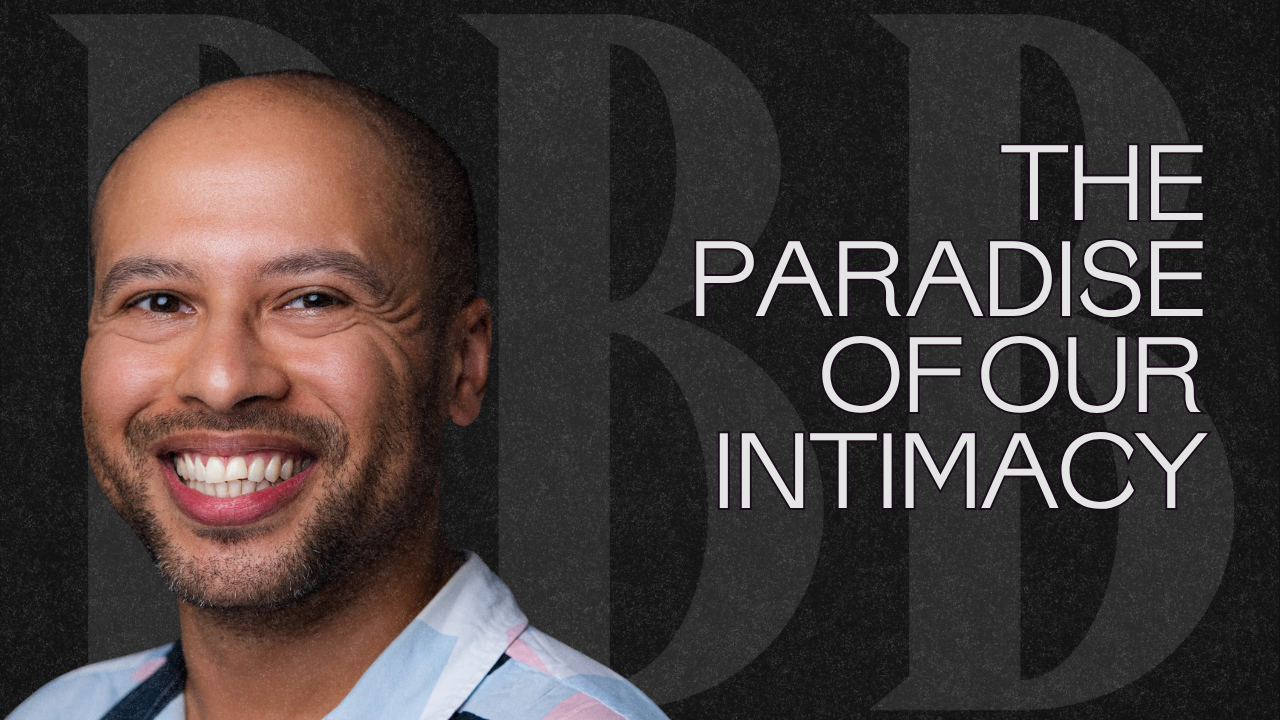
Poet and author Dean Atta returns to Busy Being Black to share how therapy, memoir-writing and an attentive archival practice have transformed his relationship with his mental health, creativity and self-acceptance.
‘Saying "there are no white people in this paradise" felt so audacious—but I made this paradise. I made it up. I can put whoever I want in it and keep out whomever I want. It felt really powerful. This is what it is to be a writer and an artist: you get to set the terms.’
DEAN ATTA
ThIS CONVERSATION is available wherever you listen to podcasts.
TRANSCRIPT
Two Black Boys in Paradise by Dean Atta, read in-show as a call and response between Dean and Josh.
Dean:
Two Black Boys in Paradise. They won't be here forever. Maybe just as long as this poem. These two black boys in paradise, two black boys — can you see them?
Josh:
These two black boys are free. These two black boys are happy. Black boys are real boys. Black boys are not just little men.
Dean:
Do you believe black boys are real? Like for real, for real — real black boys feel. These two black boys are a healing.
Josh:
Did you poison the apple already? Did you dig up the tree? Are you trying to plant these black boys in the ground?
Dean:
Did you call them apple thieves? Did you call the police? There are no police in paradise. There are no white people in this paradise.
Josh:
The two boys in this poem have black boy names. They have grown up now, but their names still suit them. Masculinity has not been required of them.
Dean:
They're in love with each other and they're in love with themselves. One kisses the other's Adam's apple. They don't make babies.
Josh:
Maybe paradise is just meant for two people at a time. Maybe it will be two black girls in paradise next time. Maybe they won't have to be boys or girls.
Dean:
Maybe it will be you in paradise with that person you have in mind right now.
Josh:
Dean Atta, I am so glad to be back in conversation with you and to be reconnected in this space. You were one of Busy Being Black's first guests, so thank you so much for agreeing to come back.
Dean:
I've been looking forward to it. I thought we'd waited long enough. It's time to return.
Josh:
To open my conversations on Busy Being Black, I ask my guests the same question: how's your heart?
Dean:
For the past few months — maybe even longer — my heart has been constantly racing. There's the physical thing of often feeling like everything's a bit too much, like I'm overwhelmed. But then I'm also really grateful for how much is happening and how many people I'm getting to do beautiful things with. Balancing the overwhelm with the gratitude, with the health concerns — it's a lot. In a more abstract way, though, my heart is very full. I feel very grateful, very blessed right now. And I'm enjoying returning to reconnect with lots of people, including yourself. I feel like there's been a time where everyone had to go off and do their own thing, and now we are finding each other again and saying: let's be together. Let's do things together.
Josh:
I love what "reconnect" brings up for me, because it makes me wonder — what made you realise you were reconnecting with someone?
Dean:
I've had some physical distance. I moved to Glasgow from London for three years, from 2019 to 2022, me and my partner. Everyone knew that's where we were — people could come visit before and after lockdown. But there was that period where we couldn't see our family and friends back in London. In some ways we got used to not seeing certain people, and it was accepted that we were seeing less of them. And then that kind of just rolled on for a while. Geography and physicality shouldn't be what determines relationships — we have so much technology, so many ways of staying in touch. It is quite funny that you can lose touch with people like that. You haven't fallen out with them. You haven't said we're not talking anymore. But you do lose touch. Sometimes people are in new relationships, or having children, or having a tough time they don't want anyone to know about, so they kind of retreat. I try and watch out for that. I try not to let my friends slip into a dark chasm and think that they're unreachable. Because I've been that way, you know. I've been that way.
Josh:
I was thinking about our first conversation — we were both coming to it with mental and emotional health really at the top of our hearts and minds. In the eight years since, how has your relationship to mental health changed or evolved?
Dean:
I've had an amazing Black queer therapist who really gets me, and sometimes is ahead of me on the topics I bring to them. It's really exhilarating — I enjoy our sessions so much. You tell them something that's happened and they get into it, and I'm like, actually I'm kind of chill about it. And they're like, oh, okay, we don't have to. It's just really funny — someone who just gets it. You never need to explain your point of view or your lived experience. They've been there, done that; they're a bit older than me. I feel in really safe hands. So I enjoy those check-ins, and they feel more like check-ins. There's rarely a crisis.
And then I wrote a memoir, so that was a really good way of taking stock of my life up to that point. My memoir came out when I was 38 — two years ago. Quite young to write a memoir, by all accounts. Everyone was like, you're so young. And I'm like, but I've lived.
I was really happy to put it all down and have my therapist by my side through that process. Now that it's been out there a while, I feel like I've drawn a line under a big chapter of my life. I call this my big man stage. I feel like a grownup, like an adult, like I can sit at the big people table. I feel a lot more comfortable in my skin, a lot more at peace. I still have times when I'm overwhelmed, times when I might withdraw, but it's more like withdrawing to recharge rather than retreating and hiding. I've just got a lot more strategies, a lot more support, and I can see the early signs of when something needs to change.
Josh:
I'm very curious about memoirs and the archive. I hadn't considered Busy Being Black as an archive until Travis Alabanza called it one, and even then I was like, no, that's something fancy curator people do. And then I was in conversation with Ajamu, the fine art photographer and archivist, as part of the Kinfolk Collective gathering, and we had this really beautiful conversation about what an archive is. Your memoir feels like a great opportunity to ask: how do we decide what is shared and what is not shared? What is kept, and what is discarded?
Dean:
Going back through my memories and my physical archive — I've got a lot of stuff. Me and my partner bought a flat this year, and my mum was like, okay, you can come and get everything from my house. So now I have all my old notebooks, everything from school, everything from when I used to perform in musical theatre. I keep things — I keep anything with my name on it, like flyers for events and programmes. I have a lot of books, many of them signed by the authors. And then I have a signed printout of "Still I Rise" by Maya Angelou, signed by her. I did an event to celebrate her 80th birthday, and she unfortunately couldn't fly because she wasn't well at the time. Artefacts have a whole story attached to them.
I've got a photograph of myself and Michael Jackson from when I was in Oliver! in the West End, and he came to see us perform and the whole company lined up to take a photo with him. But that brings up a lot for me, because the two boys closest to him are the boys who played Oliver and the Artful Dodger, and I'm just a touch behind. I used to think, when I was younger, I should have been a better actor. If I'd been Oliver or the Artful Dodger, I'd have stood next to Michael Jackson. And it really brings up how self-critical I was, even as a child. Some of that comes from being dyslexic and really struggling with reading and writing when I was young, even though I loved writing and loved storytelling. I didn't find out until I was at university, and university was so formative for me. I've got everything from there — my essays, my textbooks, my certificate saying I have dyslexia and dyspraxia, all the flyers from the poetry nights I did on campus and all the drama society plays I was in.
Josh:
Was that intentional, or did you just naturally accumulate and keep things?
Dean:
My mother is a hoarder, so partly that. But I can get rid of things I know I don't need, whereas she has clothes in every size she's ever been. I think she was hanging onto my stuff to hang onto me, but actually no — she'd rather have the space to hoard more of her own things. But yes, we kept everything. I have my confirmation certificate, my baptism certificate, so much like that. It's wonderful, and it will be whittled down at some point to give to an official archive — the stuff that's relevant to me as a writer. But I love, for myself, finding these odds and ends. Sometimes I don't recognise something at first, and then a memory comes back.
I've got a pendant with my name in hieroglyphics from a cruise from Cyprus to Egypt when I saw the pyramids for the first time. Ancient Egypt was my main obsession as a kid. And now I don't think about ancient Egypt at all. It's so interesting to think how we shift — we go from these phases that totally define us, and then we forget them. And I think if we don't have the artefacts, or a diary, or a record, we might forget who we've been, how many different versions of ourselves there have been.
Josh:
This season, different opportunities have surfaced asking for very specific things and I've had to go find documentation, going: oh my God, I forgot I curated an events programme for Tate for Zanele Muholi. I've done all this amazing work and once I've done it, it's completely out of my mind. Part of the issue with being someone who excels and just moves on to the next thing is that I've forgotten my own excellence. And when I forget it, it's like I'm learning everything from the beginning again. I always feel like I'm proving myself.
What do you think we can learn, as queer Black people, from the process of creating your memoir, around how we document and annotate and tell the story of our lives?
Dean:
Keep it. Keep it all. Not everything can be found online — we lived before the internet, before social media. I'm so grateful to have magazines from club nights where they had a photographer and then you had to go and find the free magazine and find your photo in the back. I've reconnected with people from my Bootylicious, Caribana and Dazed Days in the Black queer scene — choreographers, stylists, all sorts of wonderful people. And they remember me from the dance floor. I hardly remember me from the dance floor!
Seeing the people you used to spend time with, or finding documentation from those nights, reminds you of who you've done all of this for. Because I've strived to have stability, success, a voice, for that boy who didn't have any of that. I did a podcast recently where they asked what success looks like for me, and I was like: this. I'm successful now. I can stop trying to be successful. I can just work on my craft, work on making sure there's a chance for everyone coming up. I'm mentoring people now, trying to pay back as much as I can — because I've been mentored, I've been supported.
It's actually quite hard to pick the relevant stories and people to mention in a memoir, because a lot of people helped me in similar ways and you can't tell too many of the same stories. But I do mention Ajamu. I do mention Benjamin Zephaniah, because they had really formative moments with me where they just showed me something about myself and gave me a sense of self-belief. A lot of people were trying to tell me how to do better, how to change this or that, whereas Ajamu and Topher Campbell just saw me as me and said: you are enough. And Benjamin Zephaniah said your poetry's fantastic, keep getting it out there. And that was great.
It would be a dead world [without the arts]. If you notice, during the wars, everything was dead—and the minute you brought back the arts, everything started to live again. [Art] is an absolute, physiological necessity. It is not fluff; it is serious business.
CARMEN DE LAVALLADE
Josh:
What are some of the ways you've learned to surrender to the creative impulse?
Dean:
It's rarely lightning from the gods. The only piece of my writing that just came to me was "I'm Nobody's Nigga." That came when the killers of Stephen Lawrence were convicted — I took a breath, I sat down, I wrote it, and it was done in an hour. A synergy of a documentary I'd watched and conversations I'd been having, and it all just came out. Whereas most other things take so many drafts, so much revisiting and cringing. But I'm okay with that. I'm okay with writing up to it — there might be lots of writing before you get to where the real piece starts. I'm okay with overwriting and then realising I already wrote the piece and I've carried on for pages. I'm also okay with just note-taking and then fleshing out. From piece to piece it really depends.
When I was writing the memoir, I got into the writing by writing about where I was sat, how my body felt that day, taking in the environment, describing the room I was in — because sometimes I was at home, sometimes at my bouldering gym, sometimes in a café, sometimes in a camper van with my partner. I contextualised where I was before I got to the point. My editor was like: they don't care where you are, just tell them the thing they've come for. So that was really good discipline. I also write really well in workshops. Other people giving me prompts, having a time limit — that's really generative for me.
Josh:
Do you resist yourself? When you know something needs to come out and you say, "No, I'm not ready for that."
Dean:
No, not really. I put things in my notes app on my phone if I'm on the move. I might not revisit them — once something's there, that notebook might go somewhere else and I'll start a new one. But there may come a time when I'm ready for a piece. Some of the things I really thought were so exposing or raw or scary — give it a year or two and you're like, okay. I could fix that. It might feel unfinished because you were too emotional when writing it, or it might feel beautiful to see that raw emotion. There's nothing I'm afraid to touch. I just might not publish it. Not everything I write is going to get published, and not everything needs an audience. Sometimes it just needs to be written. That's it.
Josh:
I'm curious about the archival and memoir-writing process and your work in schools and as a mentor to other writers and poets. What do you wish people were more aware of in their own lives that you'd like to see documented, noted, honoured? And looking at a new generation, is there something you're seeing happen that you want to say: no, you have to start doing this?
Dean:
It's people waiting for others to give them permission. The people I've mentored want their families to understand their creative passions. And I'm like, why? The kids I meet want their parents to immediately and fully understand their non-binary or trans identity, and I'm like, that's a big ask. It will take time. And if people see you living it joyfully — whether that's being an artist, being trans — they will come around. I do believe that. And if not, you're going to find those people to go be joyful with. You're going to find your tribe and you are going to fly.
Being an artist is going to change you — it might change the routines of your day, your outlook, your social circle. There are some people you're definitely going to want to stay connected to, but they're going to have to accept that you're changing. If they're trying to drag you back to who you were, that shouldn't fly. You need to be the full expression of whatever self you are trying to become. You only really need to be accepted by yourself and one other person. The rest of the world might not be ready for it, but it will come with time. Young people think they need to be finished, need to know who they are, by 15. But there are 50-year-olds who don't know who they are, and that's okay. Because we are always changing.
Through poetry and playwriting I go to the limits of my being to forever discover the essence of rebirth within. My poems and plays are weapons and blessings that I use to liberate myself, to validate our realities as gay Black men and to elucidate the human struggle. What better place to celebrate this movement than on the page and on the stage.
ASSOTTO SAINT
Josh:
Talk to me about the genesis of "Two Black Boys in Paradise."
Dean:
I grew up Christian — baptised, confirmed in the Church of England, went to Church of England primary and secondary schools. My whole life was very much in the church, and the judgement of religion, the idea that homosexuality was a sin, was always something I was aware of. I used to hear this phrase: it's Adam and Eve, not Adam and Steve.
Some time ago I was asked by the Courtauld Gallery to write a piece inspired by a work of art, and I chose a picture of Adam and Eve in the Garden of Eden. I knew I needed to put two Black queer people in paradise, in Eden. A much longer poem came out — I had a brief and a time slot to fill at the performance I was going to do. I actually got to curate that night at the Courtauld, with Keith Jarrett, Travis Alabanza and Seniority Turner. We didn't bill it as a Black queer night; it was just poets responding to art. And it was beautiful.
I performed the piece there and I just knew it had a life, from the response it got. From the way people were moved, the way I was moved, the way I felt healed by saying it out loud. Because there were a lot of white people there, and saying "there are no white people in this paradise" felt so audacious. And I was like, but I made this paradise. I made it up. I can put whoever I want in it and keep out whomever I want. So it felt really powerful — this is what it is to be a writer and an artist. You get to set the terms.
The poem went through some edits and is in Still Is Love Here, but it has also become a stop-motion animation — a whole other medium. An amazing director, puppet makers, all these extraordinary people brought the boys to life. They're now called Doula and Eden, and they have a physical form. If you watch the film on Channel 4, you can see what they look like. Which is bonkers to say, because there was so little for me growing up. I didn't see myself on TV as a child. The only thing that came close was Queer as Folk, and that wasn't a great example for a 15-year-old. I feel like this is me getting to put out there what wasn't there when I was a kid, what I was so desperately looking for. And now Black queer people are seeing ourselves on TV, in all forms of media, more and more. It feels incredible.
Josh:
I just looked up the etymological root of paradise: royal enclosure. And listen to this — at the 2025 Pilgrimage Gathering, for those who are unfamiliar, there is the British Pilgrimage Trust, a charity focused on ensuring more people understand pilgrimage as a non-denominational reconnection to what David Abram calls the “animate rondure” of the Earth. One of the things I raised at the gathering was that the urban environment is also a reverential space. For so many people, paradise can be the enclosure of the city. Certain communities who don't have access to paradise in a more traditional sense, who wouldn't feel comfortable in one of the royal parks in London, are noticing paradise around themselves — they might have to steal those moments, find those enclosures within the enclosures. And I loved that it came up for me in the stop-motion: there were these two boys in the middle of an urban environment, and they chose each other and disappeared into paradise together. That says a lot about our ability as queer Black people to see each other, to tend to each other in a really beautiful way. Thank you for creating the poetic structure for that image to travel to us — that we can be paradise for each other, wherever we are.
Dean:
Absolutely that. I'm so glad that was one of your takeaways. We had to make decisions when making this poem visual — how literal is anything? The natural environment you see in the film is a real paradise. But them being together in the market stall, surrounded by people — the minute they choose to embrace, to hold hands, to kiss, that is them choosing the paradise they have between themselves. Which comes back to the earlier message: all you need is really one person to see you. And then you are seen. You can do that for yourself, but there's an extra dimension when there is another person who fully sees you and accepts you. It's not something everyone gets. And if you've felt it, you'll know it's such a special thing. That's what my relationship is for me and my partner — we see each other, the good, the bad, the messy, the inner child, the inner parent, all the shadows. And we accept. And I think if you can be accepted, and if you can accept another person, then ultimately you can accept yourself. It's so liberating. That's what we're hoping the film can offer people.
Josh:
I was very glad not to see flowers.
Dean:
Why?
Josh:
It's a real bugbear of mine — flowers as a leitmotif with Black men, as if Black men have to be softened by flowers. What I loved about the visuals accompanying this beautiful, intimate, tender, erotic poem is that these Black men, these Black boys, did not require any additional softening. The two of them were the soft place for each other to land. That says a lot.
Dean:
Absolutely. Thank you, Josh.
Josh:
Dean, to close our conversation — the word I keep arriving at is love. I don't have a question about love, but the feeling is love.
Dean:
I'm leading with love. And right now that very much has to include self-love — where I feel my health is being compromised by working or overworking, I've got to readjust my boundaries. I've got to find what you call your Divine No.
Josh:
My Divine No.
Dean:
I've got to find my Divine No. Because I haven't been saying yes for people-pleasing reasons — I've been saying yes because I see the importance of the work, and the value I'm going to add to being involved in the projects I'm asked to be part of. But if I add value, add value, and then perish — that's no good. I want to keep adding value. I want longevity: of my life, my career, my relationship. I don't want resentment to grow because I said yes to too many things. So the loving thing is to say no sometimes, so that I can show up where I absolutely have to. What couldn't be done without me. Finding that balance — do you need to do that, or is that your ego not wanting to let it go to someone else?
Josh:
Listen.
Dean:
And I'm trying to keep my ego in check as much as I can.
Josh:
For those of us who are even attentive to that — that is part of the work. Michael Meade, a mythologist — I highly recommend his podcast, Living Myth — says: creativity isn't yours. Don't let your ego believe that you are the source of creativity. You are a repetition of the original creation, and you are a channel for it. Your job is to loosen yourself up for whatever needs to come through. And I was like, yeah — what right do I have to close myself off to the fascinations of the spirit? I'm here to keep myself open.
Dean:
It's like the sculptors who say the piece is already in the marble, and you are just finding it. I love that.
Josh:
Artists are so cool. Dean, do you have a favourite poem from Still Is Love Here? And if so, will you read it to close our conversation?
Dean:
Yes. I think because we've talked about flowers, this is the perfect one, “On Days When…”
On days when you feel like a wilting garden,
gather yourself, roll up your lawn,
bouquet your flowers,
embrace your weeds.
You are a wild thing playing at being tame.
You are rich with life beneath the surface.
You don't have to show leaf and petal to be living.
You are soil and insect and root.
