
The Alchemy of Black Joy
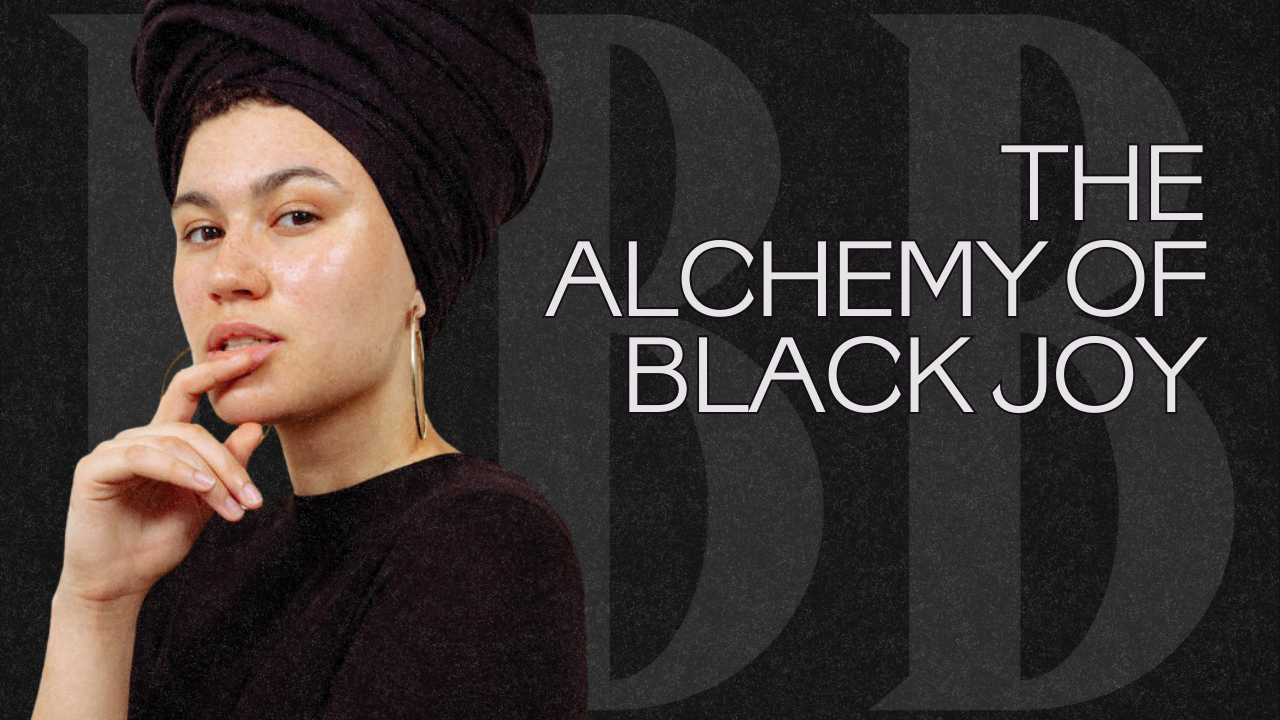
A conversation with artist, writer & curator Rosel Jackson Stern on navigating the existential absurdity of bearing witness to the enormous suffering of our times, while pursuing the joy that is our birthright.
‘Joy is my signifier. I'm a deeply joyous person, in the sense that I feel this almost golden, sun-like feeling — in my chest, or in my sacral area, even in my root. It grabs hold of me. And I know I'm on the right path when whatever I'm encountering makes the world feel like a bigger place. That is a deep signifier that I need to pay attention.’
ROSEL JACKSON STERN
ThIS CONVERSATION is available wherever you listen to podcasts and on YouTube.
TRANSCRIPT
Josh Rivers:
Rosel, I am honoured, thrilled, fizzy and delighted that you have accepted this invitation to be on Busy Being Black. Thank you so much for being here.
ROSEL JACKSON STERN:
Thank you for having me. I am gassed, delighted, beyond thrilled to be here. Busy Being Black has been so important to me in my thinking and in my development. I love this for us.
Josh:
I very much love this for us, too. As you know, to open all of my conversations on the show, I ask my guests the same question: how's your heart?
Rosel:
My heart is relieved. I had a weekend that was full of beautiful intimacy, of friends and connections. 2025 has been challenging so far, and my heart was saying, "I need people, I need touch, I need joy, I need to be in conversation with people." And spirit was just like, "Here you go." My heart is very elated and relieved that I have a place in the world, that I'm part of source and of oneness. I can know that in myself, but it's beautiful to feel that belonging with other people — especially within Sweden, which is such a deeply, racially traumatic place to live or grow up in. I'm feeling very juicy right now.
Josh:
I'm floating into this conversation after a weekend full of bucolic wonder. You know what it's like in the UK — there's a lot wrong with England specifically, but one of the things we do exquisitely is the countryside. I was at a friend's homestead about 40 minutes from my house, and the week I've had, the month I've had, the year I've had — in 24 hours, so much of what I was thinking about, theorising about, spiritualising about, landed softly and gently. I just parachuted down to earth. There have been so many times in my life where I've felt so alone and so misunderstood and so furious, locked in my own little emotional vortex. And now I have this life where a friend whisks me away to the countryside and I am lavished with the sound of children laughing and butterflies and Sea Holly, and top-down convertible drives through winding English lanes, the sea salt of the Norfolk Coast. It was bliss.
Rosel:
What I'm hearing you say is that you got to commune with nature. You got to feel the bounty of all the work you've been putting into yourself and into the world — to have those moments of ease, of joy, of reprieve from the strenuousness of consciousness, of being alive in this body. I'm so glad you got to have your greatness and ease reflected back at you. That's what I want for all of us.
Josh:
I've noticed a trend among my friends this year: we're all tussling with the same need, the same impulse and desire to find and protect ways for the softness, for the tenderness. Each of us, in our own way, is finding it quite difficult to manage our need for tenderness and solitude and quiet communion alongside the chaotic maelstrom of the world around us. How are you settling into that balance? What's helping you navigate this difficult terrain?
Rosel:
I've been relying on my community massively. The friendships and people in my life really help me process my emotions. And as a Capricorn Sun, that's a big deal.
Josh:
My Moon is in Capricorn, so I understand completely.
Rosel:
It's very that! I'm like, it's not enough to make a Google doc and bullet point all my emotions? They have to be witnessed by people? I'm learning how to be vulnerable. When I get overwhelmed, I need people to help me process that. I cannot do it by myself. I can self-soothe, I can regulate my nervous system, but part of what makes me who I am — part of how I need people — is in that way. And it took me a long time to accept it.
Josh:
What's helped with that? How did you locate the disturbance? I ask as someone who is constantly being brought to my knees before I ask for help. What has been the catalyst for walking this path towards vulnerability?
Rosel:
Like you, I've been brought to my knees so many times. I had this moment where I was making myself so ill trying to do everything alone — my body became physically ill. I was lying on the bathroom floor looking up at the ceiling, and I said to myself, honey, we've got to change something. This is not working.
I'm also someone who has dealt with a lot of suicidal ideation. I share that because I'm blessed to live somewhere where help is relatively accessible for that. It became a necessity — a matter of safety and of wellbeing — and so all the hangups I had around asking for help just fell away, because they had to.
So it's partly necessity, and then it's partly a desire for my life to be bigger. Juicier. Deeply held and felt. It's both a push and a pull — a push off the end and a pull towards something I can feel in my soul: I'm here to experience something, and that something involves other people. It involves being on the beach, receiving intimacy with no strings attached, feeling my toes in the sand and the sun on my face and fruit on my tongue. That is where my spirit team and my faith hold me. They say: you're supported. You don't have to do all of this by yourself. So I think it's necessity, humility and a deep insistence that struggle is not my story.
Josh:
"Who are you to refuse the gifts?" — that's the question I keep getting asked. And I also know the gifts aren't necessarily just for me; my whirling around in my own imagination and my own poetic delusions isn't actually very helpful to me or other people. So much like you, I'm learning the hard way that relational intimacy is the arena of my work. My challenge in this life is to ground myself in the love, in the body, in the hugs and kisses and caresses — in the sensuous, sensual world. That means confronting things I've been running from, shadows that feel scary. But that is where the work is. The work isn't actually in the imagination. It's bringing the imagination to life in ways that connect us with other people. Talk to me about how you understand spirituality broadly in your life. Can you name the entry point of the spirit into your life?
Rosel:
I grew up deeply atheist. My parents had spiritual beliefs, but it wasn't something we ritualised or practised. We also had a lot of grief early on in my family, so grief became, like, a spiritual modality. That translated into a deeply held belief that I wasn't supported — that a queer Black mixed-race body wasn't encompassed by spirit or by oneness or whatever Gods I was exposed to.
Then people came into my life who resonated with me on such a deep level that I had to sit with the fact that I didn't generate this. I didn't make these people come into my life. I didn't ask for the support they've given me. So then what is that? It can't all be me. I had to knock myself off the pedestal, out of the egoic psychosis where I was telling myself: it's just me; I am the source of all the good things that happen in my life. That became an untenable belief system.
I had to start with my ancestry. I was a deep sceptic of anything woo-woo — I was not with it. I had this deep sense of frustration, and now I can see it was grief. So I started with the acknowledgement that I'm here because other people came before me. That tied into my own identity and understanding where I'm from and how I got here — that I am the summary of many people's efforts, gifts, challenges and life experience that is as vivid as my own. That became my entry point.
Then I started with tarot. Leona Nichole Black has a beautiful community called House of Black — an online community offering different explorations of tarot — and that shaped a lot of my thinking and engagement with spirituality in the beginning. As I became more fluent in tarot, I became more fluent in meditation, and then I started energy work. All of it was to manage my own existential crisis. My own big feelings.
It would be a dead world [without the arts]. If you notice, during the wars, everything was dead—and the minute you brought back the arts, everything started to live again. [Art] is an absolute, physiological necessity. It is not fluff; it is serious business.
CARMEN DE LAVALLADE
Josh:
I love that you're expressing that spirit was working through the people around you. I can't tell you how important I think that message is — whether or not we're cut off from spirit, whether or not we're sceptics, whether or not we're reluctant to surrender to the universe or our ancestors: look around you. I've only recently, in the past year, realised that my poetry is often me speaking to myself, and it takes me a second to recognise it. In 2018, I woke up in the middle of the night and a poem came out. I thought it was a message for other people. No — that was spirit speaking to me at a time of absolute distress, and it took me five years to go: oh, wait. That's for me. And then I've looked around and thought: if I'm not worthy, why the dazzling people? Why the help? Why this support?
Rosel:
Because everyone has a divinity within them. People have this beautiful ability to mirror your own divinity back at you. Having people speak life into me when I could not speak life into myself is so awe-inspiring — so humbling. It orients me in a way that allows me to believe I'm also part of that context. What people give me is also what I give other people. Loving on my friends is my favourite activity in the world. It just is. I'm a voice note girly pop — I will send you a voice note telling you how great you are.
Josh:
I woke up to a 12-minute voice note from a friend this morning and I was giddy with excitement.
Rosel:
That joy that we feel, that love — if you have nothing else, that is enough to sustain a spiritual practice. I have all kinds of channels: my art, my self-care practice. But my relationships really were the first container for feeling that level of support and love.
Josh:
Divinity resides within each of us. Talk to me about how you approach that idea through your artistic practice.
Rosel:
I had always been painting and drawing since I was a little kid — my grandmother would put out newspapers on the kitchen floor and I'd paint all over them, paint all over myself. She had to carry me up the stairs to the bath so paint wouldn't get everywhere. Drawing has always been part of my lexicon, part of my sense of self. And then I forgot about it — you forget about parts of yourself when you're encountering the world for the first time. I forgot, and then I remembered in 2020, when I had no choice but to sit with the foundations of who I am.
I realised it was a gift I was given. I think our interests and our talents are gifts we receive when we're born — roadmaps to that divinity. For some people they manifest as a recognisable artistic practice. For others, it's support work, or policy work. Whatever lights you up is that gift.
When I paint, I commune with spirits. I channel them onto canvas. We often disagree about colours and placements. It took me a while to stop fighting that process — to stop having an argument with the spirits I was channelling, because I thought I knew best. Every painting is an exercise in surrender, in the acknowledgement that this 3D world is limited and that there are realms beyond. And because I have that relationship, I know I'm not unique. If I have it, other people have it too. I recognise divinity in other people; I feel it when I'm in conversation with them.
Josh:
For me, I know I'm supposed to pay attention to something because I'm enchanted. Enchanted is a very specific feeling: I feel fizzy, a little bit dizzy and delighted, and I'm having goosebumps — a physiological reaction. That's how I know spirit is asking me to pay attention. How does that manifest for you?
Rosel:
Through joy. Joy is my signifier. I'm a deeply joyous person, in the sense that I feel this almost golden, sun-like feeling — in my chest, or in my sacral area, even in my root. It grabs hold of me. And I know I'm on the right path when whatever I'm encountering makes the world feel like a bigger place. That is a deep signifier that I need to pay attention. The opposite is also true. The other side of feeling that joy is fear. My spirit guides are very gentle with me — they'll gently suggest a job, an opportunity, moving to another country. They allow me my process. But in the end, I always end up where they think is best for me.
Among other things, surrealism is a way to re-access forms of knowledge that we’re disconnected from: material histories, ways of being in the world, ways of healing. Many Indigenous and African traditions are rooted in the ethereal: we read the stars and rely on ancestors to guide us. For so long we have internalised the idea that these are value-less in the contemporary world. In what ways could Suzanne’s anti-imperial surrealism help us think about climate change, book bans and artificial intelligence?
NATALIE MEADE
Josh:
I was so interested to read about your 2019 dissertation exhibition as part of your degree at the University of Bristol — the connection between Afrofuturism and global politics. Where did that link come from for you?
Rosel:
It came from being a fangirl. Janelle Monáe had released Dirty Computer at the time, and me and my friends were obsessed with it because it felt expansive — like an expansive imagining of our lives. My professor at the time, Jutta Weldes, taught a course called "Popular Culture in World Politics," and she takes very seriously the idea that the media and popular culture we consume manifests in the way we relate to each other politically. That was the framework I was asked to produce this work in.
I rooted that paper in Dirty Computer because it's an Afrofuturist piece of work — it deals with how structural racism and white supremacy impact our identities and our ability to resist. The connection I had to make was arguing that white supremacy is a global political structure. Which is not hard.
Josh:
Water's wet.
Rosel:
Historically, contemporarily — water is wet. I took Dirty Computer and its analysis of fascism and put it in the framework of global politics. Afrofuturism drew me in at the time because it felt like a way of projecting Black people into the future — talking about ourselves as though our existence is a given, that our lives are prosperous, that we have a place in imagining our futures expansively.
Josh:
What I've found so invigorating about Afrofuturism as an aesthetic, an attitude and a philosophy is what José Esteban Muñoz called the "forward dawning" — casting ourselves into the future and creating a rupture with the now. We're making promises through art, through expressive poetry, through the fecund and fertile Black imagination: that we're not going to carry forward structures of harm and violence.
And it was through surrealism that I encountered Afrosurrealism. I learned that Afrosurrealism is not a sub-genre of surrealism — it's its own orientation to the world. D. Scot Miller, who wrote the Afro Surreal Manifesto in 2009, said: you wouldn't say surrealism is a sub-genre of realism. Crucially, here's the distinction between Afrofuturism and the Afrosurreal: the Afrosurreal is concerned with uncovering the now. How does that land for you, as someone who's been drawn to Afrofuturism?
Rosel:
It's a continuum that makes sense to me. From a personal journey perspective: I listened to Dirty Computer and had no hope for myself or my people. My politics were very burdened by an analysis of white supremacy — this is never going to get better. Then Janelle said: it can, as long as we direct our attention to it. So I did that. And then I realised that all the moments of liberation I was projecting towards the future actually exist in the now. They have roots in the small moments, the relational moments, the art I'm creating. If I take my joys and my pain and the relational juiciness I'm experiencing, if I take all of that seriously, I'm experiencing liberation right now.
I want to hear more about what Afrosurrealism brings up for you in relation to surrealism — how does that land with what you've uncovered?
Josh:
I love you saying this is all a continuum. This invitation from the Afrosurrealists — to come back to the moment, to uncover the hidden world that is here now — then invites us to think towards Afrofuturism. Let's take our weekends: bucolic, communal, full of relational intimacies. That's the Afrosurreal — Blackness expressing itself through the distortions of the now. There's a refusal: we will be the sunshine, we will be the intimacy. That then requires us to think Afro-futuristically — what allegiances do I need to let go of? What systems do I need to build? What technologies would help me sustain the Blackness that seeps out in joy in this moment?
I think within Afrosurrealism is also how we turn overwhelming grief into something beautiful. There's an alchemy that can only happen in the present moment.
And the last thing I’ll say on this: in the Manifesto of Surrealism, you can see [Andre] Breton's desire to capture the dream world, to label it and categorise it and measure it with the scientific — he was a student and comrade of Freud, so you can understand why a shadowy impulse lurks there. René Ménil¹ was not satisfied attaching Afrosurrealism to European surrealism, even if they were genealogically connected. Ménil was very clear: Afro-diasporic people need to be able to stand up and define ourselves for ourselves, even while accounting for history.
¹ Ménil (1907–2004) was a French surrealist philosopher and writer of the interwar period, and strictly speaking predates the coining of Afrosurrealism in 2009. I include him here because his thinking on Afro-diasporic cultural self-definition sits squarely within the Afrosurrealist tradition in spirit, if not in name.
Rosel:
I'm so grateful for your brain, for imparting this literature and framework to me. What I'm hearing is that in order to get to the future, you have to deal with whatever is present. It's not everyday escapism. It's a noble effort, but it can't be singular — because you have to engage with the grossness of the present moment. You have to feel all of it coming together, feel the pain of it, and learn how to alchemise and transmute that into, at the very least, wanting to continue. Wanting to sustain life.
The more present I can be in my life, the more tangible my future dreams feel. And it sounds like Afrosurrealism also has the capacity to acknowledge how absurd it is to be simultaneously conscious of the genocides of the world, the rise in fascism, the suffering of us as a collective — and also have weekends like we just did. It sounds like it can contain both the acknowledgement of how contradictory those experiences are and how fucking weird it gets.
Josh:
The Afrosurrealists in particular believe in the pursuit of the marvellous — that this is the human job. We are supposed to make meaning, and journey and adventure into the depths and come back with our gold. In this moment of such discord and hurt and grief, and a bigness that doesn't feel expansive but rather cloying and suffocating, the more of us who are adventuring into the unknown to find ourselves, to connect with spirit and to make beautiful things — the better. We need all of that.
I'd love to bring you into conversation with one of my favourite dancers, Carmen de Lavallade.
Carmen de Lavallade:
It would be a dead world [without the arts]. If you notice during the wars, when everything was dead — the minute you brought the arts back, things started to live again. It is an absolute physiological, emotional necessity. It is not fluff. It is serious business. I have seen people's lives change because of the arts. It doesn't mean you have to dance or sing on a stage. It is something in the human psyche that is absolutely necessary. The so-called "primitive" societies know that. Modern man has gotten away from it, much to the detriment of young people. When they took all the arts out of the schools: trouble. Because they had somewhere for that energy to go — into paintings, into music. We always had that, and it was taken away. Imagination is a powerful thing, and if it's used properly, it would be a much better world. An exciting world, too.
Rosel:
She puts into words what so many artists feel — that their practice is a necessity. Not optional. I think of creativity as the ability to make something out of nothing, and humans do it all the time. The colonisation of work on our time is truly devastating for this ability. We get concerned with money, with prestige, with social capital because it's become integral to our survival. And what does that do for our inherent ability to create, to process through making? There is nothing more destructive than creative people without a creative outlet. The same ability that allows you to create — whether from experience, emotion or the material of your spirit — can also be turned inward into destructive behaviours and into controlling the outside world. It creates its own psychosis. That is the consequence of robbing people of their time and energy to create.
Josh:
I'm always very curious about what other artists and creatives are looking for in other people's work. For me, I'm always looking to be punched in the gut — to be provoked to anger, to disgust, to enchantment. I'm looking for something big and bodacious. What are you looking for?
Rosel:
I'm looking for peace.
Josh:
The contrast there.
Rosel:
I recently saw Sinners, and the amount of recognition — the putting together of images and words to this feeling I have around my own creative process — it was, in some ways, a gut punch. But one that levelled me up into a new sense of peace. There are feelings and thoughts and nebulous, nagging sensations I carry internally — something that needs to be expressed, that needs to come out — and I don't have the range to do it. So when other artists have that range and bring it into fruition, there's a deep satisfaction. It's a constriction and then a release. Am I just looking for orgasms in art? Maybe that is what it is.
There's a journalist at the New York Times called Wesley Morris, and he did a beautiful analysis of Bruno Mars and the racial politics of his career. I don't care about Bruno Mars — I'll go on the record. It's not my thing. But because I listened to Wesley Morris articulate why he cares, and the evolution of that care, I now understand why I feel the way I feel. The point isn't the subject matter — it's the beauty of putting together an argument that is emotive, factual and concise, that tells a story and is precise in its analysis. That's crack. That's what I want more of. Do it to the point where I'm relieved I don't have to, because you can do it so well.
Josh:
"I'm glad you can bleed on the page, 'cause I can't."
Rosel:
For real! I just focus on whatever my lane is, and collectively we've got it covered. It's the opposite of being in a terrible group project where you feel like you have to do everything because it's not going to get done otherwise. Good art is being like: I have amazing peers, and they have perfected something that I have no interest in perfecting. That is what I look for — the satisfaction and peace of that.
Josh:
To close our conversation: how might you coax a queer Black artist to creation in this moment? Maybe they're uncertain, unsure, don't know where to begin. Maybe they feel overwhelmed with rage or grief or a kaleidoscope of emotions simultaneously. What would Rosel say?
Rosel:
First, I would say: it's okay to feel however you are feeling. Make sure you have structures of support around you, even if that's just you for right now. What are the habits? What are the small moments, the pockets of joy you can find in your life that give you reprieve from the general overwhelm of being alive? They have to be tiny. They just have to be tiny. You give them some attention and love and they will grow, and they will grow to feed you. And when you are fed, you can make a healthy decision about where to channel your energy. You cannot start a journey without some tools, without some sustenance. Figure out what your sustenance is, and you are then open to all of the answers that are already in front of you.
For every fear that you have, there's a future you that's not worried about it. Sit in that and you can produce, you can make, you can be — and sometimes being is enough. Have faith in your ability, in the people who came before you. And I cannot wait to see what you make.
Josh:
Rosel, thank you so much for this beautiful conversation — for the improv and the lyric and the poetry and the romance of it all. Thank you so much.
Rosel:
Thank you. You're a gift to this world, Josh.
BUSY BEING BLACK TRANSCRIPTS ARE EDITED FOR LENGTH, CLARITY & FURTHER LEARNING.
WATCH: The Alchemy of Black Joy
